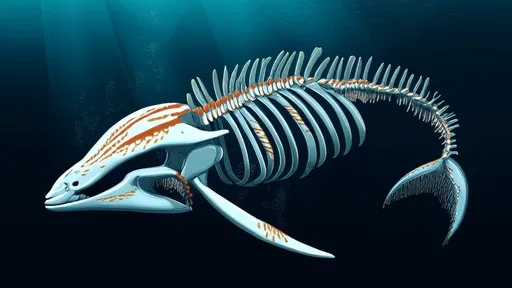
In the profound darkness of the deep ocean, where sunlight never penetrates, an extraordinary ecological phenomenon unfolds—one that challenges our understanding of life and energy transfer in the most inhospitable environments on Earth. This process, known as whale fall, begins with the death of a great whale and its subsequent descent to the seafloor. Over decades, its massive carcass becomes the foundation for a complex, thriving ecosystem, supporting everything from scavengers to specialized bacteria. Recent scientific efforts have focused on quantifying the intricate energy transfer within these unique ecosystems, revealing insights that reshape our comprehension of deep-sea productivity and carbon sequestration.
The journey of a whale fall ecosystem starts with the arrival of the carcass on the seabed. Almost immediately, mobile scavengers such as hagfish, sleeper sharks, and amphipods descend upon the bounty. This initial stage, known as the mobile-scavenger stage, can last from several months to a few years, depending on the size of the whale and local environmental conditions. During this phase, an estimated 40 to 60 percent of the soft tissue is consumed. The sheer biomass of a single whale, which can be equivalent to thousands of years of background organic flux in these food-scarce depths, represents a monumental pulse of energy entering the system. Researchers have begun to meticulously measure consumption rates, biomass removal, and the caloric intake of these scavengers to build a quantitative model of energy flow.
Following the scavenger stage, the enrichment-opportunist stage commences. This period is characterized by a high-density aggregation of organisms that colonize the bones and remaining soft tissue. Polychaete worms, crustaceans, and other invertebrates thrive on the organic material enriched by the whale fall. The density of organisms can be staggering, with some studies reporting over 50,000 individuals per square meter on and around the carcass. Quantification here involves not just counting organisms but measuring their metabolic rates, growth, and reproductive output. Scientists use specialized equipment like respirometers and stable isotope analysis to track how carbon and nitrogen from the whale are incorporated into the tissues of these opportunists, effectively mapping the transfer of energy from one trophic level to another.
The final and longest phase is the sulfophilic stage, which can persist for decades. Here, anaerobic bacteria break down lipids embedded within the whale bones, producing hydrogen sulfide as a byproduct. This sulfide supports chemosynthetic bacteria, which in turn form the base of a food web that includes mussels, clams, tube worms, and other specialized fauna akin to those found at hydrothermal vents. The energy transfer in this stage is chemosynthetically driven, a stark contrast to the photosynthetic base of most surface ecosystems. Quantifying energy in this phase is particularly challenging. Researchers measure sulfide production rates, bacterial productivity, and the growth rates of the endemic fauna. Recent studies using in situ experiments and long-term observatories have estimated that a single large whale fall can provide a continuous energy source for up to 50 years, supporting a succession of communities and contributing significantly to local biodiversity.
The quantification of energy transfer in whale fall ecosystems is not merely an academic exercise; it has profound implications for our understanding of the global carbon cycle. Whales, as large carbon reservoirs, sequester significant amounts of carbon in their bodies during their lifetimes. Upon death, this carbon is transported to the deep sea, where a portion is integrated into deep-sea sediments for centuries or even millennia. By accurately measuring how much energy and carbon are consumed, recycled, or sequestered at each stage of the whale fall process, scientists can better model the ocean's biological pump—the process by which carbon is transferred from the atmosphere to the deep ocean. Current estimates suggest that whale falls may sequester approximately 190,000 tons of carbon per year globally, a figure that underscores their previously overlooked role in climate regulation.
However, this research is fraught with challenges. The deep sea is an incredibly difficult environment to study. The high pressure, darkness, and remoteness require sophisticated and expensive technology like remotely operated vehicles (ROVs) and autonomous underwater vehicles (AUVs). Furthermore, finding a natural whale fall is a matter of chance, though scientists have begun deploying carcasses at predetermined sites to study the process systematically. These programmed whale falls have been instrumental in collecting replicable data on colonization rates, species succession, and energy metrics. Despite these advances, the vastness of the ocean floor means that our current data is still sparse, and each new discovery adds a piece to the puzzle.
The story of the whale fall is a powerful testament to life's resilience and interconnectivity. From the death of a leviathan emerges a cradle of biodiversity, a deep-sea oasis that sustains life for generations. The meticulous work to quantify its energy dynamics is peeling back the layers of this mystery, revealing a system of remarkable efficiency and importance. As we continue to explore the depths, the humble whale fall stands as a symbol of how much we have yet to learn about our planet and the silent, vital processes that occur far beneath the waves.
By /Aug 27, 2025

By /Aug 27, 2025

By /Aug 27, 2025
By /Aug 27, 2025
By /Aug 27, 2025

By /Aug 27, 2025
By /Aug 27, 2025
By /Aug 27, 2025
By /Aug 27, 2025
By /Aug 27, 2025
By /Aug 27, 2025
By /Aug 27, 2025

By /Aug 27, 2025
By /Aug 27, 2025
By /Aug 27, 2025
By /Aug 27, 2025
By /Aug 27, 2025
By /Aug 27, 2025
By /Aug 27, 2025
By /Aug 27, 2025
